The Cavalier
Stephen King Three Classic Novels Box Set: Carrie, 'Salem's Lot, the ShiningThe Cavalier is a town-limits tavern and roadhouse whose seemingly routine nightlife becomes one of the central physical settings of the Spring Ball disaster. It is where young people drink, listen to loud country music, pursue sexual encounters, and imagine conventional futures; it is also where Christine Hargensen and Billy Nolan prepare the attack on Carrie White. When Carrie reaches it after the massacre, the building becomes a terminal site of pursuit, collision, fire, and death. The Cavalier therefore marks the point at which Chamberlain's ordinary social world and its concealed cruelty meet in the same room.
A Familiar Local Institution
The tavern belongs to the everyday geography of Chamberlain. Thomas Ross imagines a future in which he will spend Friday and Saturday nights at his uncle's place or at The Cavalier, drinking beer and talking about an old baseball triumph before settling into marriage, political habits, and the predictable ownership of last year's car model. That fantasy gives the roadhouse a deliberately unheroic atmosphere: it represents an adulthood of repetition, local memory, drinking, and inherited routine rather than escape.
Christine Hargensen knows the establishment well. She had first entered its taproom two years earlier with a forged identification card, and she reflects that its record selection has not changed since then. The place's stale continuity contrasts with the apparently decisive plans being made upstairs. The jukebox plays Ray Price's "She's Got To Be a Saint," while the same room preserves the habits and sounds of the past, making The Cavalier feel less like a neutral backdrop than a sealed social circuit from which its patrons have never really moved.
Meeting Place for the Prom Prank
On the night of the Ewen Spring Ball, Christine Hargensen and William Nolan meet in a room above The Cavalier. The White Commission records that they had been meeting there for some time, although the surviving account cannot determine whether their plans were already complete and irrevocable or whether the final decision emerged on a whim. The uncertainty is significant: the roadhouse shelters both deliberation and impulsiveness, allowing a sustained campaign of revenge to coexist with the reckless mood of a night out.
Christine's relationship with Billy is also bound to the room. She has refused to sleep with him until the previous Monday, when he promised that he and his greaser friends would help her arrange the attack on Carrie White if Carrie dared attend the prom with Tommy Ross. Their earlier encounters at The Cavalier had involved intense physical making out, described through the pair's differing vocabularies, while Christine had intended to keep Billy waiting until he had actually accomplished something. The room thus holds the mixture of erotic bargaining, manipulation, resentment, and violence that drives their partnership.
When they leave by the back stairs, Christine feels an excitement growing inside her. The concealed exit and the upstairs room emphasize the covert nature of the plan: above the public drinking space, the prank is treated as a private conspiracy; below it, music and ordinary commerce continue without acknowledging what is being prepared.
Nightlife, Noise, and Concealed Violence
The Cavalier's atmosphere is built from sound and distraction. During the disaster, the downstairs band plays at full volume, with five musicians in sequined cowboy shirts and new pegged jeans, while the music covers the town whistle, the first explosion, and the second. Even the gas-main explosion fails to reach the room immediately. The establishment's entertainment system becomes a mechanism of isolation, keeping those upstairs asleep while Chamberlain begins to burn.
The same building also accommodates the town's rougher male rituals. On the night before the prom, Thomas K. Quillan recalls playing stud poker in the back room with other men when he became convinced that Fast Marcel Dubay was cheating. After drinking several beers, Quillan went to the police station and had himself locked in Holding Cell Number 1 by Jacob Plessy. The episode presents The Cavalier as a place where aggression, alcohol, camaraderie, and local authority overlap; the tavern is not outside the town's institutions but connected to them through personal familiarity and habitual behavior.
The Final Confrontation
At 11:20 P.M., Christine Hargensen and Billy Nolan return to The Cavalier after carrying out the blood prank. They go upstairs by the back stairs, and Billy immediately begins pulling at Christine's blouse. Their encounter becomes a violent struggle rather than a continuation of the night's triumph. She spits in his face, and the two descend into an unconscious, thrashing fight while the music continues below. Because the band is still playing loudly, no one hears the town's alarms or the explosions outside.
Jackie Talbot eventually reaches their room after the news spreads. His eyes are wild and his face is smeared with soot; from Brickyard Hill he had seen the Jackson Avenue gas main explode, and on the drive back he had found the town in panic. He tells Billy that Chamberlain is burning, that the school and the Center are gone, that West End has exploded, and that Carlin Street is on fire. He also reports the emerging accusation that Carrie White caused it all. His arrival breaks the room's enclosure, bringing the catastrophe that the music had kept at a distance into the conspirators' private refuge.
The account of the disaster makes The Cavalier a point in the chain of destruction. Jackie explains that Carrie and Tommy Ross won King and Queen, that buckets of blood were dumped on them, that Carrie ran out, and that the school then caught fire. He lists subsequent explosions at Teddy's Amoco and the Citgo station on Summer Street. The Cavalier is not merely near these events: it is where their perpetrators receive the first chaotic explanation of the consequences, while still trying to understand whether the town's destruction can be connected to their own act.
Destruction and Narrative Significance
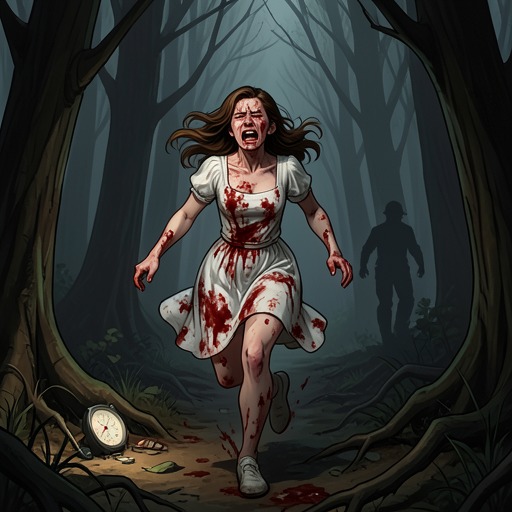
Billy and Christine leave through the empty dance hall, where chairs remain pushed back and beers stand flat on the tables. The abandoned hall preserves the physical remains of a celebration that has become irrelevant. Outside, when Billy switches on the car's headlights, they see Carrie standing about seventy feet away. She is covered in dirt, grass stains, and blood, much of it her own, with the hilt of Margaret White's carving knife protruding from her shoulder. Having crawled from Carlin Street while half fainting, Carrie has come to destroy the roadhouse, perhaps the very place where the plan that set the disaster in motion began.
The encounter turns the building from refuge into trap. Carrie exerts control over Billy's car, making it turn traitor in his hands; the Chevvy circles in a smoking half-circle and crashes into The Cavalier at forty miles per hour while still accelerating. Wood sprays from the clapboard wall, the gas tank splits, and spilled fuel catches fire when part of a straight pipe falls into it. The crash gives the roadhouse a final, material expression of the violence cultivated within it: the secret room, the prank, the sexualized aggression, and the town's wider collapse converge in an impact that destroys both the vehicle and the building.
The Cavalier's significance lies in this transformation. It begins as a symbol of local routine and imagined adult normality, then becomes the hidden headquarters of revenge, a soundproof chamber for violence, an information point where the disaster is belatedly recognized, and finally a target of Carrie's retaliation. Its unchanged records, flat beer, back stairs, loud band, and ordinary talk make the catastrophe more disturbing rather than less. The roadhouse shows how the social world that treats cruelty as entertainment can become the structure through which that cruelty returns.